
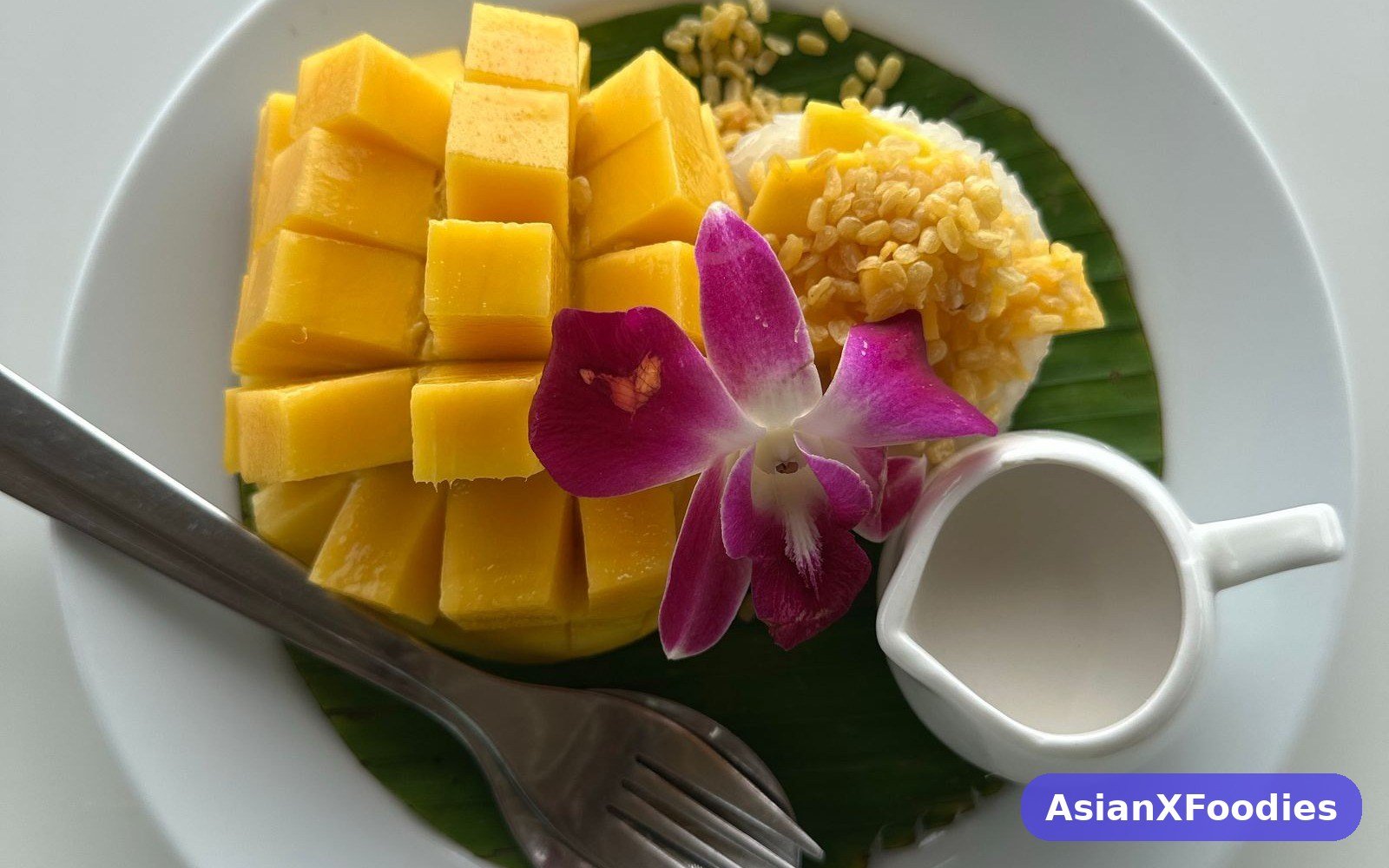
Mango Sticky Rice with Coconut Cream
I first ate mango sticky rice on a hot evening in Bangkok, sitting on a low plastic stool at a night market, with the air thick with the smell of grilled corn and frying bananas. A woman in an apron was scooping rice from a steamer into little plastic tubs, pouring coconut cream over the top from a jug, and laying slices of mango alongside it, and I watched her for a while before I ordered, because there was something so calm and practised about the way she worked. When I finally took a spoonful, I understood why people queue for it. The rice was warm and soft and faintly sweet, the mango was ripe to the point of being almost too soft, and the coconut cream was salty just enough to make the sweetness sing. I ate the whole tub standing up, and then I bought another one, and I have been chasing that exact taste ever since.
Making it at home took me a few tries to get right, and I will be honest about that, because the first time I made it the rice was gluey and the sauce was thin, and the second time the mango was not ripe enough and the whole thing tasted flat. But the third time, when I finally soaked the rice overnight and bought mangoes that smelled sweet at the stem, it worked, and it worked so well that my family now asks for it every time mangoes are in season. It is a simple dessert, really, just three things, rice and mango and coconut, but the simplicity is deceptive, because each of those three things has to be right. The rice has to be steamed, not boiled, so it stays separate and chewy. The mango has to be ripe, so ripe that it almost falls apart when you slice it. And the coconut cream has to be seasoned with salt, because without that pinch of salt the whole dish tastes one-note and sweet.
What I love about making this at home is how quiet the process is. There is no oven, no mixer, no complicated technique, just soaking and steaming and stirring, and the kitchen fills with the smell of coconut and warm rice. It is a dessert that asks you to slow down a little, to soak the rice the night before, to wait while it steams, to let it rest in the coconut milk until it has absorbed every drop. In a kitchen where everything is usually rushed, that slowness feels like a gift. And when you finally sit down with a plate of it, warm rice and cold mango and silky cream, it tastes like summer, even if it is raining outside. If you are planning a Thai meal and want a main course to go before it, my simple Thai chicken curry without coconut milk is a lovely, lighter curry that leaves room for dessert.
Why You’ll Love This Recipe
You will love this recipe because it is one of those desserts that tastes far more special than the effort it takes, and because it is made from ingredients that are easy to find and easy to keep. Glutinous rice, which is also sold as sticky rice or sweet rice, keeps for months in the cupboard, coconut milk keeps for months in the tin, and mangoes, when they are in season, are everywhere. There is no baking, no setting, no chilling for hours, and no special equipment beyond a steamer, which can be as simple as a metal sieve over a pan of boiling water. I have made this in a tiny kitchen with almost no equipment, and it still turned out beautifully, because the method is forgiving and the ingredients do the work.
The flavour is the real reason to make it, though, and it is hard to describe without sounding like I am exaggerating. The rice is sweet and creamy and a little bit chewy, the mango is floral and honeyed, and the coconut cream on top is rich and salty, and together they make something that is more than the sum of its parts. It is not a heavy dessert, and it does not leave you feeling overfull, which is why it is such a perfect ending to a spicy meal. After a hot curry, a plate of mango sticky rice feels cooling and gentle, and the contrast between the warm rice and the cool mango is one of the great pleasures of Thai cooking. I have served this to people who said they did not like rice pudding, and watched them ask for seconds, because this is nothing like the rice pudding they were thinking of.
It is also a dessert that suits almost everyone. It is naturally gluten-free, and it is vegan if you use a plant-based sugar, and it contains no eggs, no dairy, and no nuts unless you choose to add them as a topping. I have made it for friends with allergies, for children who are picky about desserts, and for my grandmother, who is hard to please and who asked me for the recipe, which is the highest praise I know. You can make it ahead, you can scale it up for a crowd, and you can dress it up with toasted sesame seeds or crispy mung beans, or keep it simple, and it will still be lovely. That is a rare combination, and it is why this dessert has become one of my most requested recipes.
Ingredients You’ll Need
- 1 1/2 cups Thai glutinous rice (sticky rice), rinsed
- 1 can (400 ml) full-fat coconut milk
- 1/3 cup sugar, plus 1 tablespoon for the topping sauce
- 1/2 teaspoon salt, plus a pinch for the topping sauce
- 2 large ripe mangoes, preferably Ataulfo or honey mangoes
- 1 tablespoon rice flour or cornstarch, mixed with 2 tablespoons water
- 1 pandan leaf, tied in a knot (optional)
- 1 tablespoon toasted sesame seeds, for serving
- 2 tablespoons toasted mung beans, for serving (optional)
- Fresh mint leaves, for serving (optional)
The rice is the ingredient that matters most, and it is worth getting right. You need Thai glutinous rice, which is a short-grain rice that becomes sticky and chewy when it is steamed, and it is sold in Asian supermarkets and in the world foods aisle of most large supermarkets. Do not use jasmine rice or basmati rice, because they will not become sticky, and do not use sushi rice, because it is a different kind of stickiness and the texture will be wrong. The bag will usually say glutinous rice, sticky rice, or sweet rice, and any of those names is correct. I buy it in large bags now, because once you start making this dessert you will want to make it again, and it keeps for a long time in a sealed container.
The mangoes are the second thing that matters, and they are worth choosing with care. You want mangoes that are ripe, which means they give slightly when you press them gently, they smell sweet at the stem end, and their skin has a little give. Ataulfo mangoes, which are small, yellow, and kidney-shaped, are the best for this dessert, because they are sweet, floral, and almost fibreless, and they slice beautifully. Honey mangoes are similar, and they are worth buying when you see them. Avoid the large, green-red Tommy Atkins mangoes if you can, because they are often fibrous and not sweet enough, and a mango that is not sweet enough will make the whole dessert taste flat. I buy my mangoes a few days before I plan to make this, and I leave them on the counter until they are perfectly ripe, and I check them every morning, because the window between ripe and overripe is short, and it is worth getting it right.
How to Make Mango Sticky Rice with Coconut Cream
Start the night before, or at least four hours before you plan to eat, by rinsing the glutinous rice. Put the rice in a large bowl, cover it with cold water, and swish it around with your hand until the water turns cloudy, then drain it and repeat, two or three times, until the water runs mostly clear. This rinsing matters, because it washes away the excess starch that would make the rice gummy, and gummy is not what you want, you want rice that is sticky but still distinct, each grain holding its shape. Once the rice is rinsed, cover it with fresh cold water, by about two inches, and leave it to soak. I soak mine overnight, because it is the easiest way to remember, and in the morning the rice has swollen and turned opaque and white, and it is ready to steam. If you are in a hurry, four hours is the minimum, and six hours is better, but do not skip the soaking, because unsoaked glutinous rice will not cook evenly, and you will end up with hard centres and mushy outsides.
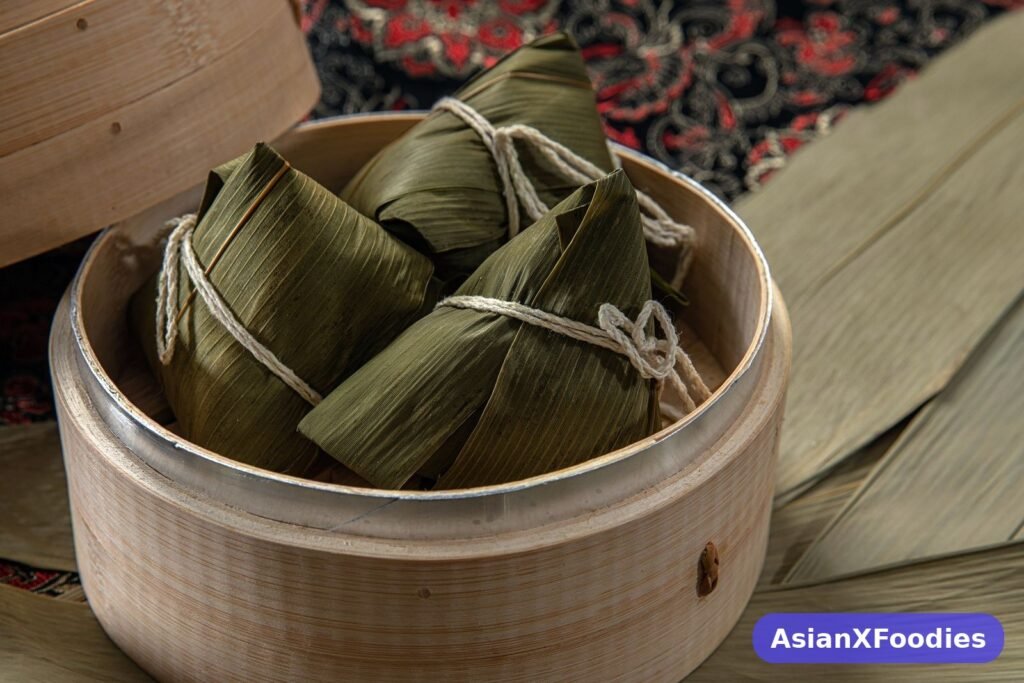
To steam the rice, drain it well and spread it in a thin layer in a steamer basket lined with cheesecloth or a clean tea towel. A bamboo steamer is traditional and wonderful if you have one, but a metal steamer basket or a sieve set over a pan of boiling water works just as well, and I have used both many times. Bring the water to a boil, set the steamer over it, cover it with a lid, and steam the rice for twenty to twenty-five minutes, until it is tender and translucent and sticky. Halfway through, I like to turn the rice over with a spoon, so the top and bottom cook evenly, and I check a grain by pressing it between my fingers, because it should be soft all the way through with no hard centre. If the rice is still firm, steam it for another five minutes. The smell of the steaming rice is warm and nutty, and it fills the kitchen in a way that makes me feel calm, because it is a slow, gentle kind of cooking.
While the rice is steaming, make the coconut sauce, and this is where the dessert really comes together. Pour the coconut milk into a saucepan, and add the sugar, the salt, and the pandan leaf if you are using it, and warm it over medium-low heat, stirring gently, until the sugar has dissolved completely. Do not let it boil, because boiling can make the coconut milk split, and a split sauce looks grainy and unappealing. Taste it, and you will notice something interesting, because the sauce should taste sweet, but also salty, and that salt is what makes the dessert work. It should taste a little too salty on its own, because once it is mixed with the plain rice it will be perfect. Take about a third of this sauce out and set it aside for serving, because you will want a separate, thicker sauce to drizzle over the top, and the rest will go into the rice. To the reserved sauce, add the rice flour slurry, and cook it gently for a minute or two, stirring, until it thickens slightly, and then set it aside to cool. The Kitchn’s mango sticky rice recipe uses the same two-sauce method, and reading it helped me understand why the topping sauce is thicker than the soaking sauce.
When the rice is done, tip it while it is still hot into a large bowl, and pour the warm coconut sauce over it, the larger portion, not the thickened topping sauce. Stir it gently with a wooden spoon, folding rather than mashing, until the rice is evenly coated, and then cover the bowl with a lid or a plate, and leave it to rest for twenty minutes. During those twenty minutes the rice will absorb the sauce and swell and turn glossy, and when you lift the lid it will smell incredible. I always sneak a spoonful at this stage, because I cannot help myself, and it is the best spoonful in the whole recipe, warm and sweet and creamy. While the rice rests, peel the mangoes and slice the flesh away from the stone, cutting it into thin slices or neat cubes, and keep them covered so they do not dry out. To serve, spoon a mound of warm rice onto each plate, arrange the mango slices alongside it, drizzle over the thickened coconut cream, and sprinkle with toasted sesame seeds or crispy mung beans if you have them.
Tips for the Best Mango Sticky Rice
The first tip is to soak the rice properly, and I mean properly, not just for an hour while you do something else. Glutinous rice needs time to absorb water evenly, and if you rush it, the outside will cook before the inside, and you will have rice that is both mushy and hard at the same time, which is the worst of both worlds. Overnight is best, and it is also the easiest, because you can rinse and soak the rice in the evening and forget about it until morning. If you remember in the afternoon that you want this for dinner, four hours is the absolute minimum, and I would set a timer so you do not forget. I have a small note on my fridge now that says soak the rice, because I have forgotten more times than I care to admit, and a forgotten soak means no mango sticky rice that day.
The second tip is about the salt, and it is the tip that surprises people most. You need more salt in the coconut sauce than feels sensible, because the rice is plain and the mango is sweet, and without salt the dessert tastes flat and one-dimensional. I use half a teaspoon in the sauce, and a pinch in the topping, and I taste the sauce before I pour it over the rice, and it should taste sweet and salty at the same time, like salted caramel. If you are nervous, add the salt in two goes, tasting as you go, but do not leave it out, because it is the difference between a good mango sticky rice and a great one. The first time I made this without enough salt, my husband said it was nice, which is the polite way of saying it was forgettable, and the next time, with proper salt, he asked for seconds.
The third tip is to serve the rice warm and the mango at room temperature, because the contrast is part of the pleasure. Cold rice is firm and less fragrant, and warm mango is too soft and loses its freshness, so the balance matters. I steam the rice, let it rest in the sauce, and serve it while it is still warm, with mango that has been sitting on the counter, not in the fridge, and the combination is perfect. If you have made the rice ahead and it has cooled, warm it gently in the steamer for a few minutes, or in the microwave with a damp cloth over it, and it will soften again. Do not reheat the mango, and do not pour hot sauce over cold mango, because the mango will go mushy and lose its bright flavour.
Variations to Try
The simplest variation is to add colour, and it is a beautiful one. In Thailand, mango sticky rice is sometimes made with rice that has been soaked with butterfly pea flowers, which turn it a soft blue, or with pandan, which turns it pale green, and both look stunning on a plate. To make the blue version, soak the rice in water with a handful of dried butterfly pea flowers, and the rice will absorb the colour. For a green version, add pandan extract to the soaking water, or cook the rice with a pandan leaf. I have made the blue version for a birthday, and it was the most photographed dessert I have ever served, because it looks like something from a dream. The flavour is the same, but the colour makes it feel special.
You can also change the fruit, and this is a good option when mangoes are out of season or expensive. Ripe peaches, sliced thin, are lovely with the coconut rice, and so are ripe bananas, though they should be added at the last minute so they do not brown. In winter, I have made this with tinned mango, drained well, and it is not as good as fresh, but it is still a lovely dessert, and it is better than no mango sticky rice at all. For a richer version, stir a spoonful of coconut cream into the rice instead of the thinner milk, and for a lighter version, use light coconut milk, though the sauce will be thinner. If you want a warm, spiced version, add a pinch of cinnamon to the coconut sauce, which is not traditional but tastes wonderful in autumn. And if you are building a Thai menu, BBC Good Food’s Thai recipes collection is a lovely place to browse for a main course, because a good Thai meal deserves a good Thai dessert.
Serving Ideas
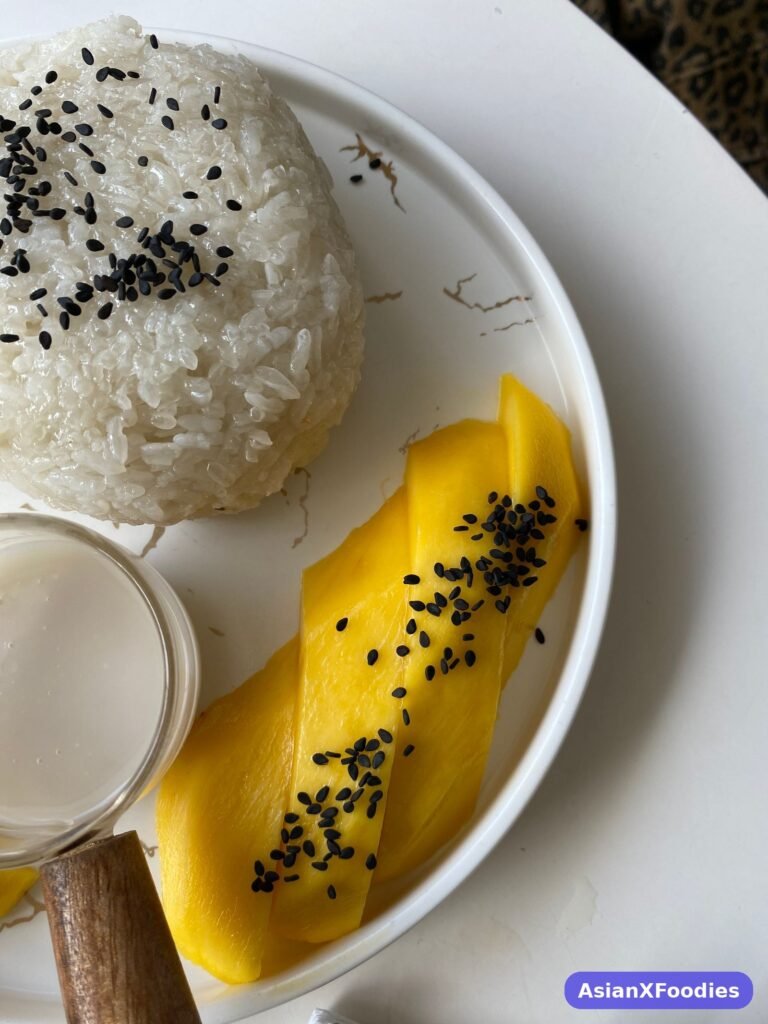
The classic way to serve this is on a plate, with a neat mound of rice and fanned slices of mango, and a drizzle of coconut cream over the top, and I would not change it. I like to use a small bowl as a mould, pressing the warm rice into it and then turning it out onto the plate, because it gives a beautiful dome shape, and the mango arranged around it looks like it belongs in a restaurant. Sprinkle toasted sesame seeds or crispy mung beans over the top, because they add a crunch that contrasts with the soft rice, and a mint leaf or two makes it look fresh and pretty. Serve it while the rice is still warm, with the mango at room temperature, and eat it with a spoon, because a spoon gets the perfect ratio of rice and mango and cream in every bite.
For a crowd, I serve it family-style, with a big bowl of rice in the middle of the table, a platter of sliced mango, and a jug of coconut cream, so everyone can help themselves. This works well for a summer barbecue or a Thai-themed dinner party, because people can take as much or as little as they want, and the dessert feels relaxed rather than formal. I have also served individual portions in small glass bowls, with the rice at the bottom, the mango on top, and the cream drizzled over, and they look beautiful and feel a little more special. If you are serving this after a spicy meal, keep the rest of the meal simple, because the dessert is the star, and it deserves a little space. My easy homemade vegetable spring rolls without deep-frying make a lovely light starter for that kind of meal, and my Vietnamese cucumber salad with peanuts and lime is a fresh, crunchy side that balances a rich main course.
On the side, you do not need much, because this dessert is complete on its own. A cup of jasmine tea is perfect, and so is a glass of iced coconut water, which echoes the coconut in the dessert. If you want something to drink that is a little more special, a Thai iced tea, with its sweet, spiced flavour, is a lovely partner, though it is quite sweet, so serve it in a small glass. Avoid anything too heavy or too rich, because the dessert is already creamy, and you want something clean and refreshing alongside it. A few extra slices of mango on the side, for people who want more fruit, is a nice touch, and a bowl of toasted sesame seeds on the table lets everyone add their own crunch.
Storage and Reheating
Mango sticky rice is best eaten the day it is made, and I will be honest about that, because the rice is at its softest and most fragrant when it is fresh. But leftovers are still good, and I have eaten them happily for lunch the next day. Store the rice and the mango separately, in airtight containers in the fridge, for up to two days. The rice will firm up in the fridge, because glutinous rice hardens when it gets cold, and the mango will soften, so the texture will not be quite as perfect as it was fresh, but the flavour will still be lovely. Keep the coconut sauce in a separate container, and store any sesame seeds or mung beans in a dry container, because they go soft if they are stored with the rice.
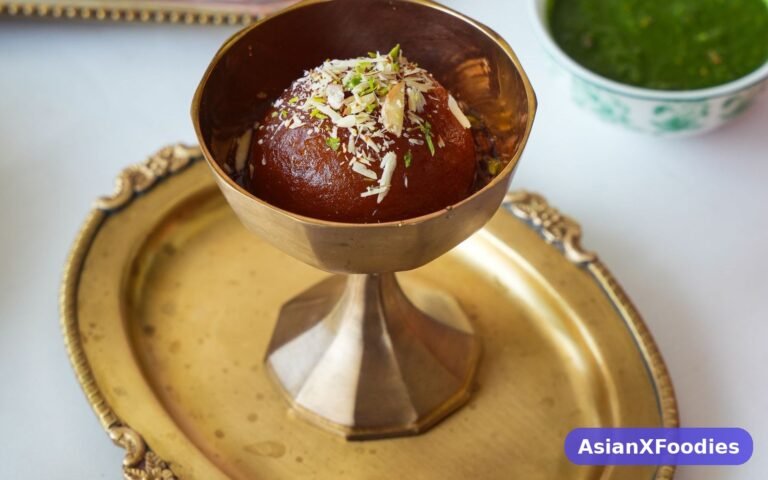
To reheat the rice, sprinkle it with a tablespoon of water, cover it with a damp cloth, and warm it in the microwave for a minute, or steam it for five minutes until it is soft and warm again. Do not overheat it, because it can go gluey, and do not reheat the mango, because warm mango is not pleasant. Serve the reheated rice with fresh mango if you have it, or with the leftover mango at room temperature, and drizzle over the coconut sauce, which you can warm gently in a saucepan. I would not freeze this dessert, because the rice goes hard and grainy when it thaws, and the mango loses its texture completely, so it is better to make a smaller batch and eat it fresh. For another dessert that keeps well and is easy to make ahead, my gulab jamun with cardamom syrup is the one I turn to, because it actually improves after a day in the syrup.
Frequently Asked Questions
Can I make mango sticky rice without a steamer?
Yes, and it is easier than you think. You can use a metal sieve or a colander set over a pan of boiling water, with a lid on top, and it works just as well as a bamboo steamer. You can also cook the rice in a rice cooker, using the same amount of water as rice, though the texture will be a little softer. I have even made it in a microwave, in a covered bowl with a little water, though I would not recommend it, because the texture is harder to control. A steamer is best, but a sieve over a pan is a perfectly good substitute.
What is glutinous rice, and does it contain gluten?
Glutinous rice is a type of short-grain rice that becomes sticky when it is cooked, and despite its name, it contains no gluten at all. The name comes from the Latin word for glue, because the rice is sticky, not because it contains gluten. It is naturally gluten-free, and it is safe for people with coeliac disease, as long as the other ingredients are gluten-free too. Look for it in Asian supermarkets, where it is sold as glutinous rice, sticky rice, or sweet rice, and check the label if you are unsure.
How do I know if a mango is ripe enough?
A ripe mango gives slightly when you press it gently, it smells sweet at the stem end, and the skin has a little give. It should feel heavy for its size, and the colour should be warm and golden, though colour alone is not a reliable guide, because some varieties stay green when they are ripe. If your mango is still hard, leave it on the counter for a few days, and it will ripen. If it is very soft and wrinkled, it is overripe, and it will still taste sweet, but it will be hard to slice neatly, so use it for a smoothie instead.
Can I use canned coconut milk instead of fresh coconut cream?
Yes, canned full-fat coconut milk is what this recipe uses, and it works beautifully. Do not use light coconut milk, because the sauce will be too thin, and do not use coconut cream from a carton, because it is often sweetened. Shake the tin well before you open it if you are making the sauce, because you want the cream and the milk mixed together, and use the whole tin. If you can find fresh coconut milk, it is lovely, but canned is what most Thai cooks use at home, and it is perfectly good.
How long does mango sticky rice last in the fridge?
It will keep for up to two days in the fridge, stored in separate containers, but it is best eaten the same day. The rice firms up as it cools, and the mango softens, so the texture changes, though the flavour stays good. I would not keep it for longer than two days, because the mango will start to ferment and the rice will go hard. If you want to make it ahead, make the rice and the sauce the day before, and slice the mango on the day you serve it, and it will taste almost as good as fresh.
Can I make this dessert less sweet?
Yes, and it is easy to adjust. Reduce the sugar in the coconut sauce from a third of a cup to a quarter of a cup, and taste it before you pour it over the rice. The mango adds a lot of sweetness, so if your mangoes are very ripe, you may not need as much sugar. You can also add a little more salt, which balances the sweetness without adding sugar. I make a less sweet version for my mother, who does not like very sweet desserts, and she loves it, because the coconut and the mango are sweet enough on their own.

One Comment